
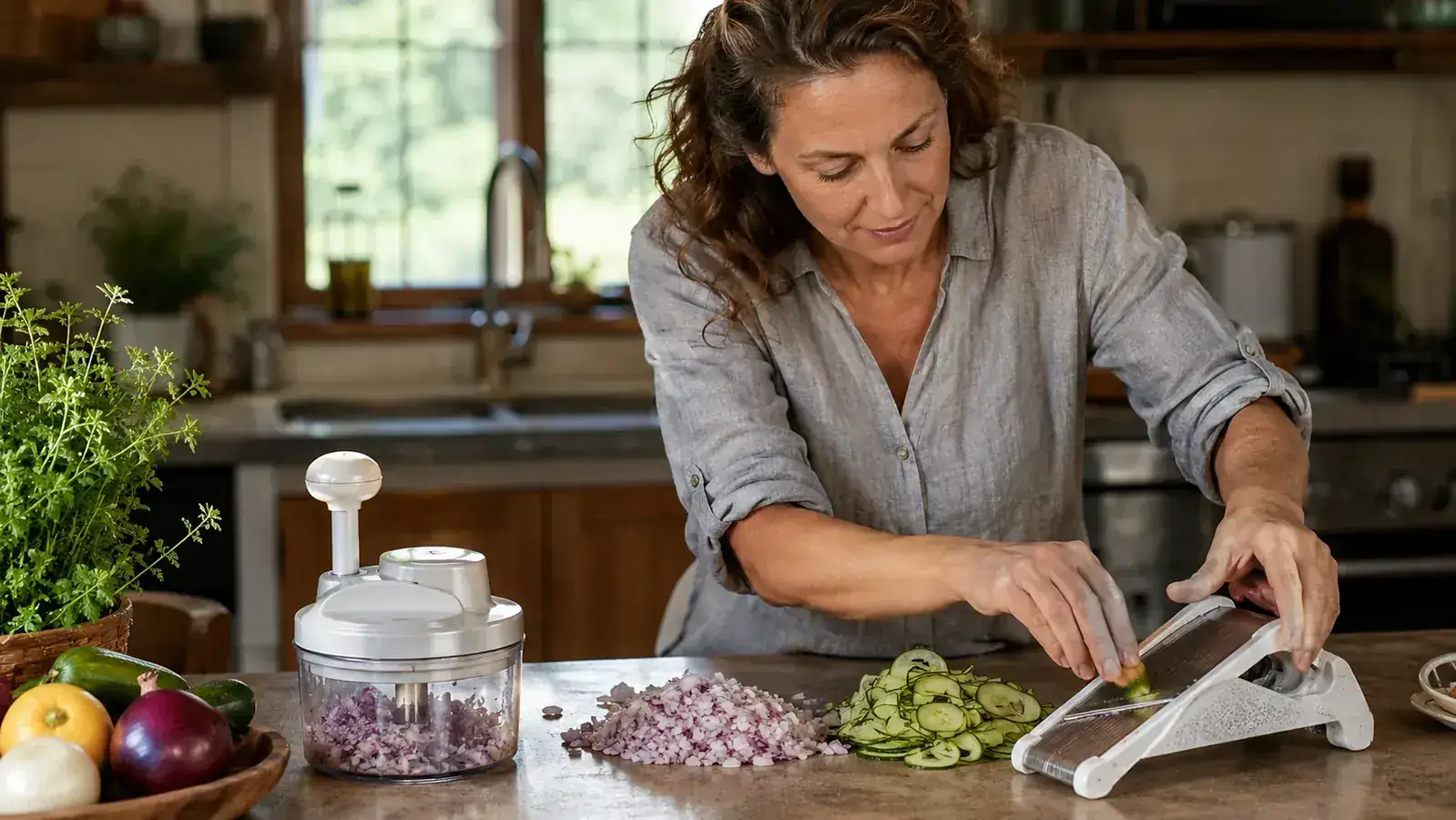
I have a drawer in my kitchen that used to be a graveyard for gadgets I bought with good intentions and never touched again. The Fullstar vegetable chopper is not in that drawer. It sits out on the counter next to the coffee maker because I use it four or five nights a week, usually while I'm also trying to keep my youngest from feeding green beans to the dog under the table. My mandoline slicer, on the other hand, lives in that drawer and comes out when I'm making something specific, usually a gratin or a big batch of pickled cucumbers for a potluck. People ask me which one they actually need, as if it's a single answer. It isn't. They solve two different problems, and after using both for real weeknight cooking for over a year, I can tell you exactly where each one earns its space and where it doesn't.
Short version: if your goal is getting a pile of diced onion, pepper, and cucumber into a bowl in under a minute with almost no cleanup, the Fullstar chopper wins, and it isn't close. If your goal is paper-thin, perfectly even slices for something like scalloped potatoes or a layered salad, a mandoline slicer still does that job better than the Fullstar ever will. Most home cooks need the first thing far more often than the second, which is why the chopper is the one I recommend to almost everyone who asks. But I want to be honest about where the mandoline still beats it, because pretending one tool wins every category is how people end up with the wrong gadget.
| Fullstar Vegetable Chopper | Mandoline Slicer | |
|---|---|---|
| Speed on a mixed dice (onion, pepper, tomato) | One press per vegetable, done in under a minute total | Each vegetable needs to be sliced first, then hand-diced from the slices |
| Thin, uniform slicing (potato, cucumber, radish) | Not built for it, blades are chopping grids, not slicing blades | Purpose-built for this, adjustable thickness settings give paper-thin even slices |
| Finger and blade exposure | Blades are enclosed inside the chopping unit, hand never touches the cutting surface | Blade is exposed and angled, requires a guard or a cut-resistant glove for safety |
| Cleanup after use | Diced food collects in an attached container, rinse three pieces and it's done | Loose slices scatter across the cutting board, plus a flat exposed blade to wash carefully |
| Storage footprint | Bulkier, container and blade discs need a dedicated cabinet spot | Flat and thin, slides into a drawer alongside cutting boards |
| Versatility of cuts | Dice, mince, spiralize, and julienne with swappable blade inserts | Mostly straight slices and julienne strips, no dicing function |
| Learning curve | Load, press, done, no technique required | Takes a few uses to get comfortable with the angle and pressure without wasting food |
Where the Fullstar Chopper Wins
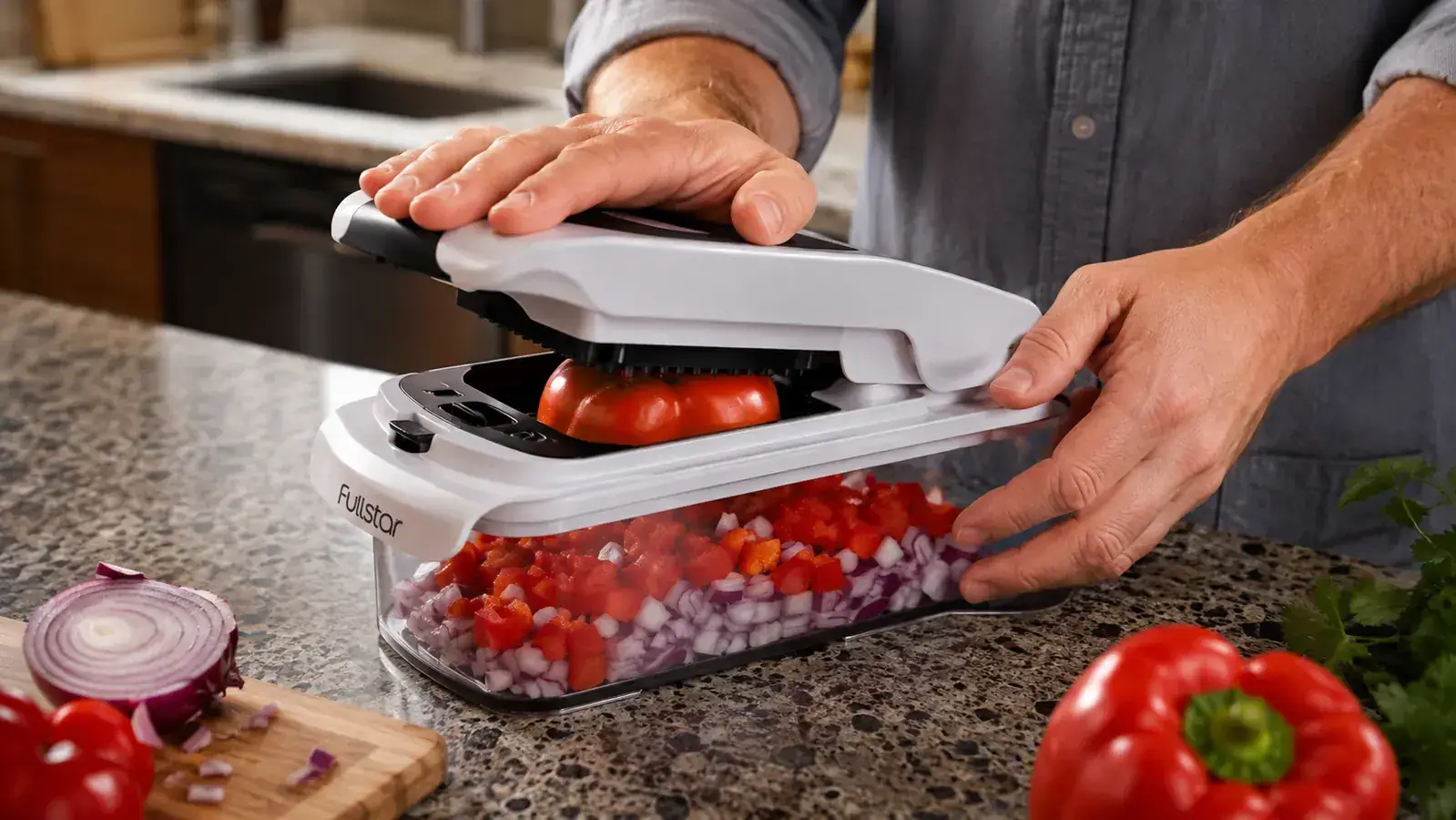
The whole reason I bought the Fullstar in the first place was Tuesday nights, when I'm making tacos for five people and I need diced onion, diced tomato, and diced bell pepper on the table in the time it takes the meat to brown. With a knife, that's ten minutes of steady chopping and a cutting board covered in juice and seeds. With the Fullstar, I split the onion in half, drop it cut-side down into the hopper, and press the handle straight down once. It's diced. Same with the pepper, same with a couple of Roma tomatoes. Three vegetables, maybe ninety seconds total, and everything lands in the attached container instead of all over my counter.
The enclosed blade design is the other reason it stays out on my counter instead of getting put away. My oldest is twelve and has started helping with dinner prep, and I am comfortable letting her load vegetables into the chopper and press the handle because her fingers never get near a cutting edge. That is simply not true of a mandoline. A mandoline's blade sits exposed and angled toward whatever you're pushing across it, and even adults with steady hands nick a knuckle on one eventually. If you have kids in the kitchen or you're the kind of cook who tends to get distracted mid-prep, the enclosed design alone is worth the drawer space.
Cleanup is the third thing that actually decides whether a gadget gets used again, and this is where the Fullstar quietly wins the most loyalty. Because the diced food falls straight into a clear container instead of scattering across a cutting board, there's nothing to scrape or chase. I pull the container off, dump it into whatever pan or bowl I'm using, rinse the blade insert and the container under hot water, and I'm done in under a minute. Compare that to a mandoline, where I'm not just rinsing a slicing surface, I'm being careful about where my fingers go while I do it.
Where the Mandoline Slicer Wins
I'll say this plainly because too many comparison articles pretend one product wins everything: for thin, uniform slices, the mandoline is still the better tool, and I don't reach for the Fullstar when I need that job done. Scalloped potatoes need every slice to be roughly the same thickness so they cook evenly, and a chopper's grid blades simply aren't built for that kind of precision slicing. A mandoline's adjustable thickness dial lets me dial in something almost see-through for a potato gratin, or a bit thicker for a cucumber salad, and every piece comes out consistent. I have tried to fake thin uniform slices with the Fullstar and the results are always a little uneven, because the blades are designed to chop into cubes, not shave into sheets.
The mandoline also wins on storage footprint if drawer space is genuinely tight for you. Mine is flat, maybe half an inch thick, and slides in next to my cutting boards without taking up any real room. The Fullstar's container and blade discs need a dedicated spot in a lower cabinet, which isn't a problem for me but might be for someone working with a truly small galley kitchen. It's a small thing, but if you're already fighting for cabinet space, it's worth factoring in before you buy a second gadget you don't have anywhere to put.
For the nightly dice-and-mince work that eats up most of your prep time, the Fullstar is the one that actually gets used.
If your kitchen reality is fast weeknight meals and you're tired of a knife and cutting board eating fifteen minutes before dinner even starts, this is the tool that solves that specific problem. Check today's price on Amazon.
Amazon Check Today's Price on Amazon →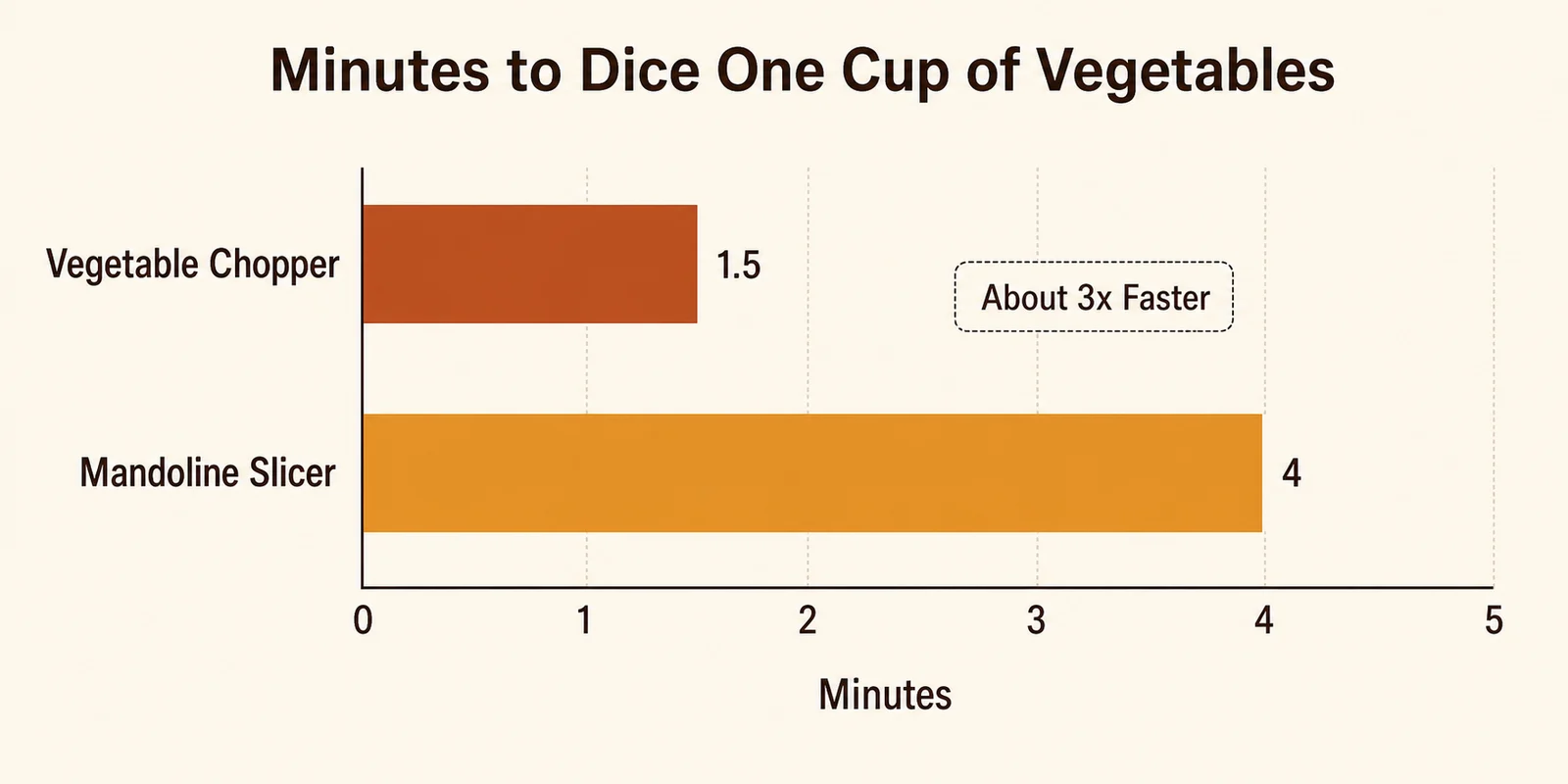
The Real Difference: Speed Versus Precision
Once you stop thinking of these as competing products and start thinking about what job each one is built for, the choice gets a lot easier. A chopper is optimized for speed on irregular cuts. It doesn't care if every piece of diced onion is exactly the same size, it just needs them small enough to cook evenly in a pan, and it gets you there in seconds instead of minutes. A mandoline is optimized for precision on uniform cuts. It doesn't dice anything, but if you need forty identical potato slices for a layered bake, it does that job with a consistency a knife or a chopper cannot match by hand.
In my kitchen, roughly eighty percent of what I cook on a given week needs the fast, irregular dice: soups, tacos, stir-fries, salsas, omelets, stir-in vegetables for pasta. The remaining twenty percent needs the precision slicing: gratins, chip-style snacks, layered salads, pickling projects. That ratio is why the Fullstar earns its spot on my counter and the mandoline earns its spot in the drawer instead of the trash. If your weekly cooking leans heavily toward one side of that split, whichever tool matches your actual habits is the one worth buying first. You will notice how you cook once you start paying attention to it this way, and it usually settles the debate faster than reading spec sheets does.
Safety and Cleanup, the Parts Nobody Talks About Enough
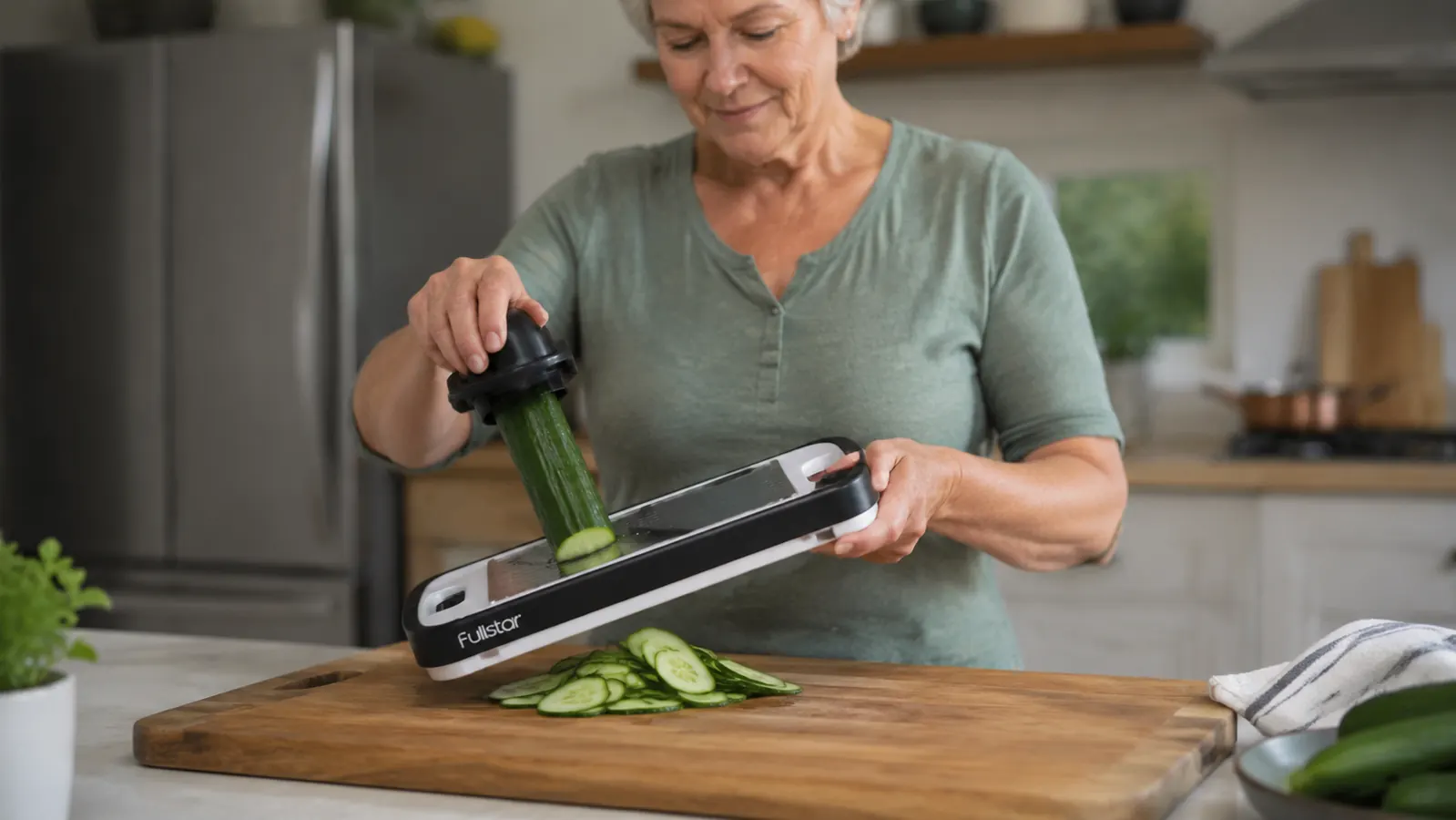
I mentioned the enclosed blade already, but it's worth saying again because it changes how you actually use the tool day to day, not just in theory. With the mandoline, I am always a little bit present with my attention on my hand position, especially toward the end of a vegetable when there's less to hold onto and the blade guard becomes less reliable. That's not a defect in the mandoline, it's just the nature of an exposed slicing blade. With the Fullstar, that tension isn't there. I can be half-watching a pot on the stove while I press the chopper handle, because there's no way for my hand to reach the blade even if I got careless.
Cleanup ties back into whether a gadget actually gets used long-term, and I've watched this play out with friends who bought a mandoline expecting it to replace their cutting board entirely. It doesn't take long before the extra step of carefully hand-washing an exposed blade starts to feel like friction, and the mandoline drifts back into the drawer for good. The Fullstar's rinse-and-go cleanup is a bigger part of why it stayed in my regular rotation than the chopping speed itself. A gadget that's a hassle to clean gets used less and less no matter how good the actual cutting performance is.
The mandoline makes the most beautiful potato gratin I've ever plated. The Fullstar is the reason dinner actually gets on the table on a Tuesday.
Who Should Buy Which
If you cook mostly weeknight meals, soups, tacos, stir-fries, salsas, or anything that needs onion, pepper, tomato, or cucumber diced fast and without ceremony, get the Fullstar first. It's also the better choice if you have kids helping in the kitchen, if you find prep work is the part of cooking you dread most, or if you've bought a mandoline before and stopped using it because of the exposed blade. For most home cooks reading a comparison like this one, that describes the majority of your actual cooking week, which is why I recommend it as the default pick and point people toward the full long-term review if they want more detail on how it holds up over months of use.
Get a mandoline slicer, or add one alongside the Fullstar, if you regularly make dishes that depend on thin uniform slices: potato gratins, layered vegetable bakes, homemade chips, or pickling projects where consistent thickness affects how evenly everything cooks or cures. A mandoline is also worth it if you cook for a crowd often enough that presentation matters, since evenly sliced vegetables simply look more finished on a plate than a rough dice does. If you're building out your prep drawer from scratch and can only buy one tool right now, start with the chopper for the everyday wins, and pick up a mandoline later once you know how often you actually need that thin, uniform cut. If you want to see how much time this actually saves across a real week of meals, our meal prep guide walks through it.
It handles the eighty percent of prep work you're actually doing on a normal night.
Weeknight dicing, mincing, and quick prep, done in seconds instead of standing at a cutting board. If that's most of your cooking week, this is the tool that earns its drawer space. Check today's price on Amazon.
Amazon Check Today's Price on Amazon →