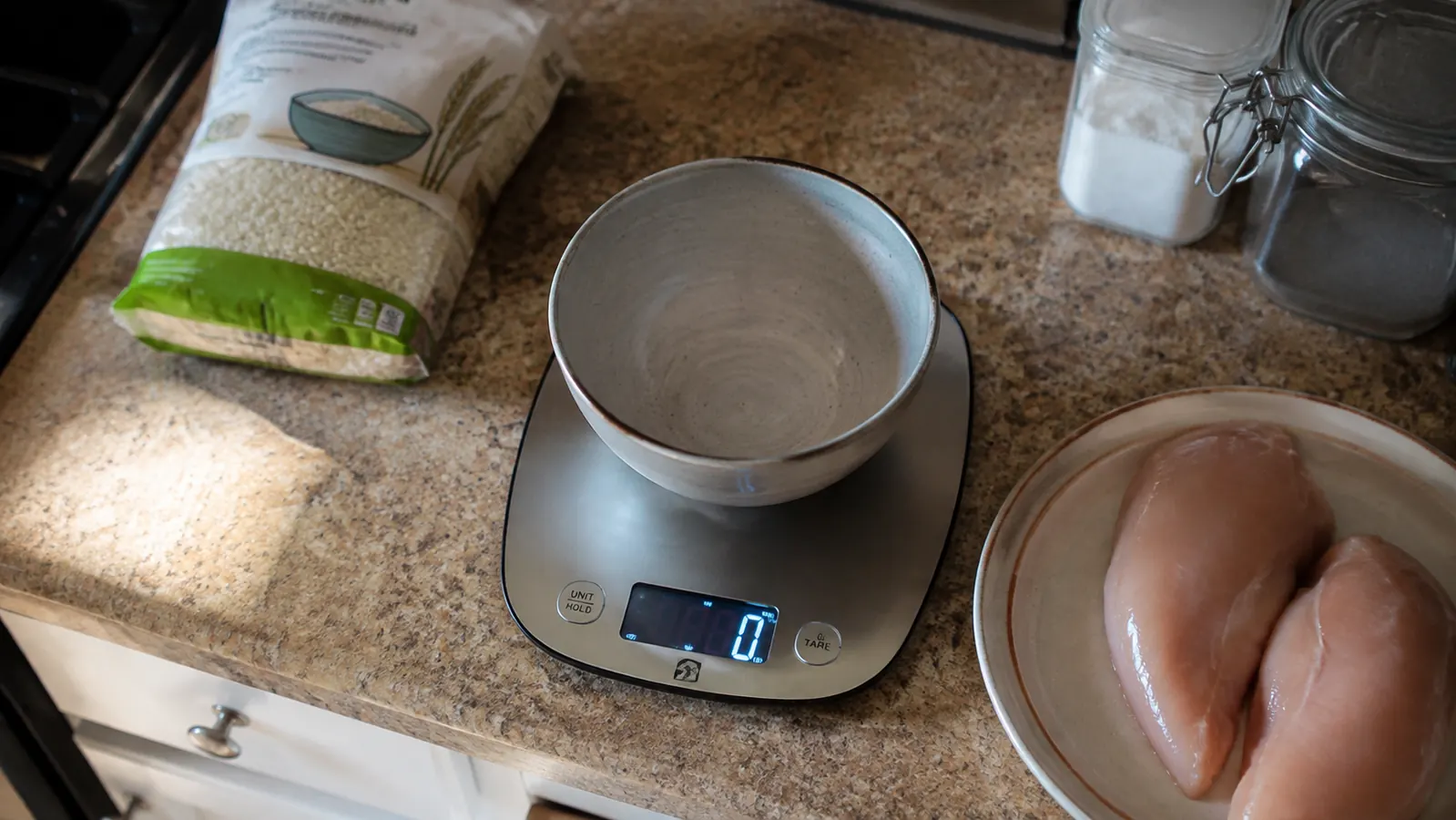
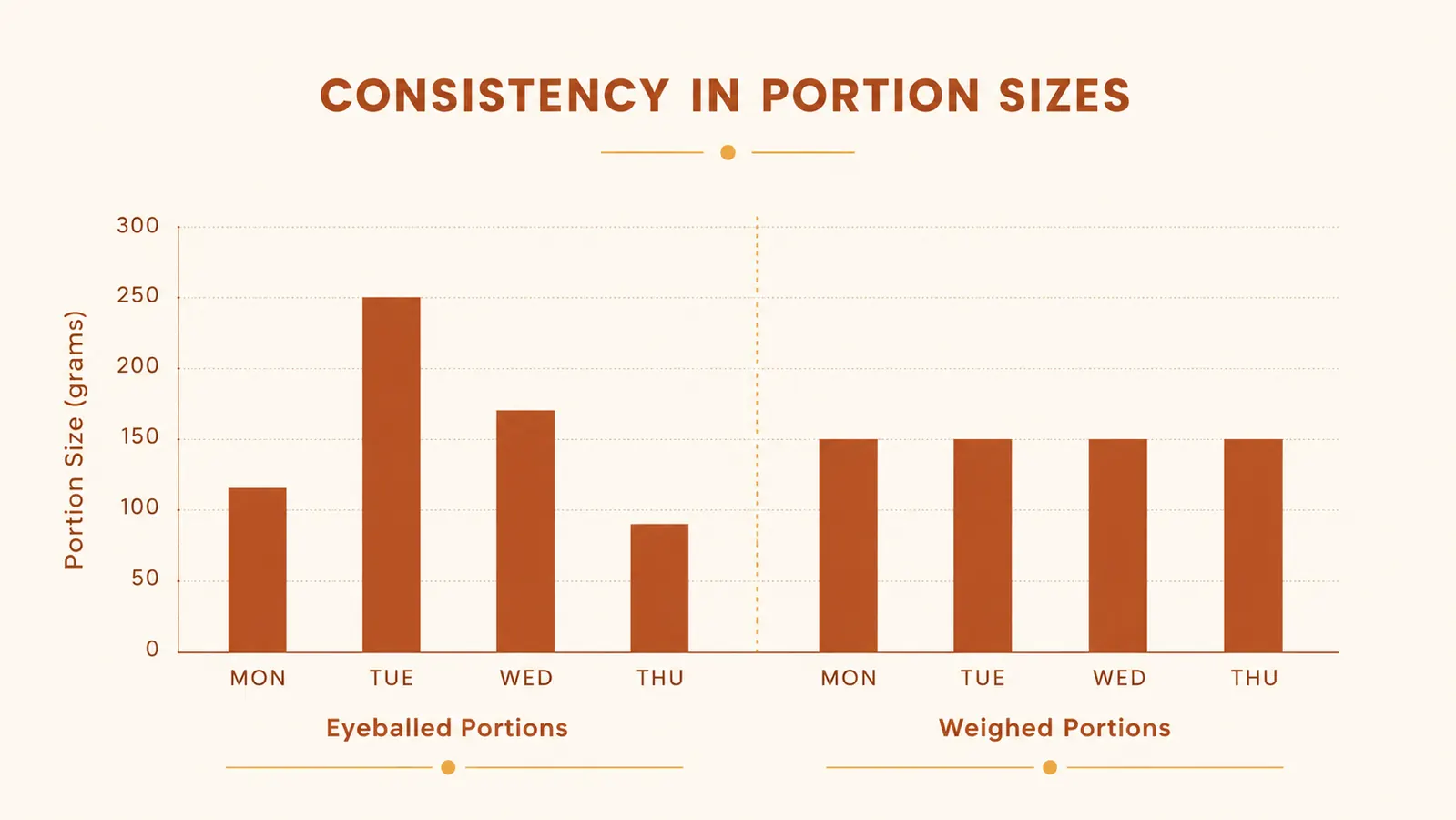
For years I portioned everything by eye. A chicken breast looked "about right," a scoop of rice looked "about a cup," and by Thursday I'd either run short of what I needed for the week's last meal or find myself with two extra chicken breasts thawed and no plan for them. What actually fixed it wasn't a new recipe or a stricter routine, it was buying a plain stainless steel digital kitchen scale, an Etekcity, and using it every time I cooked something meant to be split into more than one serving. The scale didn't change what I cooked. It changed whether five servings of the same dinner actually came out the same size, instead of three normal ones and two that were basically appetizers.
This isn't a diet plan or a calorie-counting system, it's a consistency system. If you cook for more than one person, or you're trying to make a batch of something stretch across a week of lunches, or you just want the container you pack for tomorrow to match the one you packed yesterday, a scale solves that in a way a measuring cup mostly can't. Cups measure volume, and volume is a poor stand-in for weight when you're dealing with shredded chicken, cooked rice, or a chunk of ground beef that packs down differently depending on how hard you press it into the cup. I get into the specifics of why that gap matters in this comparison of scale versus measuring cups, but the short version is this: weight doesn't lie about density the way a cup does.
In my house that's four people with four different appetites, so "one serving" was never going to be a single fixed number anyway. What the Etekcity scale gave me wasn't a rule to follow, it was a way to see the pattern. Once I knew my teenager's dinner plate ran heavier on protein than mine by a specific amount, I could portion for that on purpose instead of guessing wrong in one direction or the other every night. It also settled arguments about who got the bigger piece, since the plate in front of each person was weighed the same way as everyone else's, not just handed out by whoever was closest to the stove when the pan came off the heat.
Stop guessing at portions and start weighing them
A scale that sits flat on the counter and reads in grams or ounces is the cheapest fix for meals that come out a different size every time you cook them.
Amazon Check Today's Price on Amazon →Step 1: Zero out the scale with your container already on it
Every scale worth using has a tare button, and it's the one feature that makes portioning by weight practical instead of annoying. Set your empty bowl, plate, or container on the Etekcity scale first, press tare or zero, and the display resets to zero with that container's weight subtracted out automatically. From there, whatever you add reads as the actual weight of the food, not the food plus the dish it's sitting in. Skip this step and you'll spend the whole session doing subtraction in your head, which is exactly the kind of friction that makes people give up on a scale after the first week.
I keep the Etekcity scale on a flat, stable spot on the counter rather than anywhere near the edge or on top of a towel or trivet, since anything uneven underneath it throws the reading off by more than you'd expect. If I'm switching between a bowl and a plate mid-session, I re-tare for each one rather than assuming the numbers still line up. It takes one extra second and it's the difference between a portion that's actually accurate and one that just looks close enough.
Step 2: Weigh proteins before they hit the pan
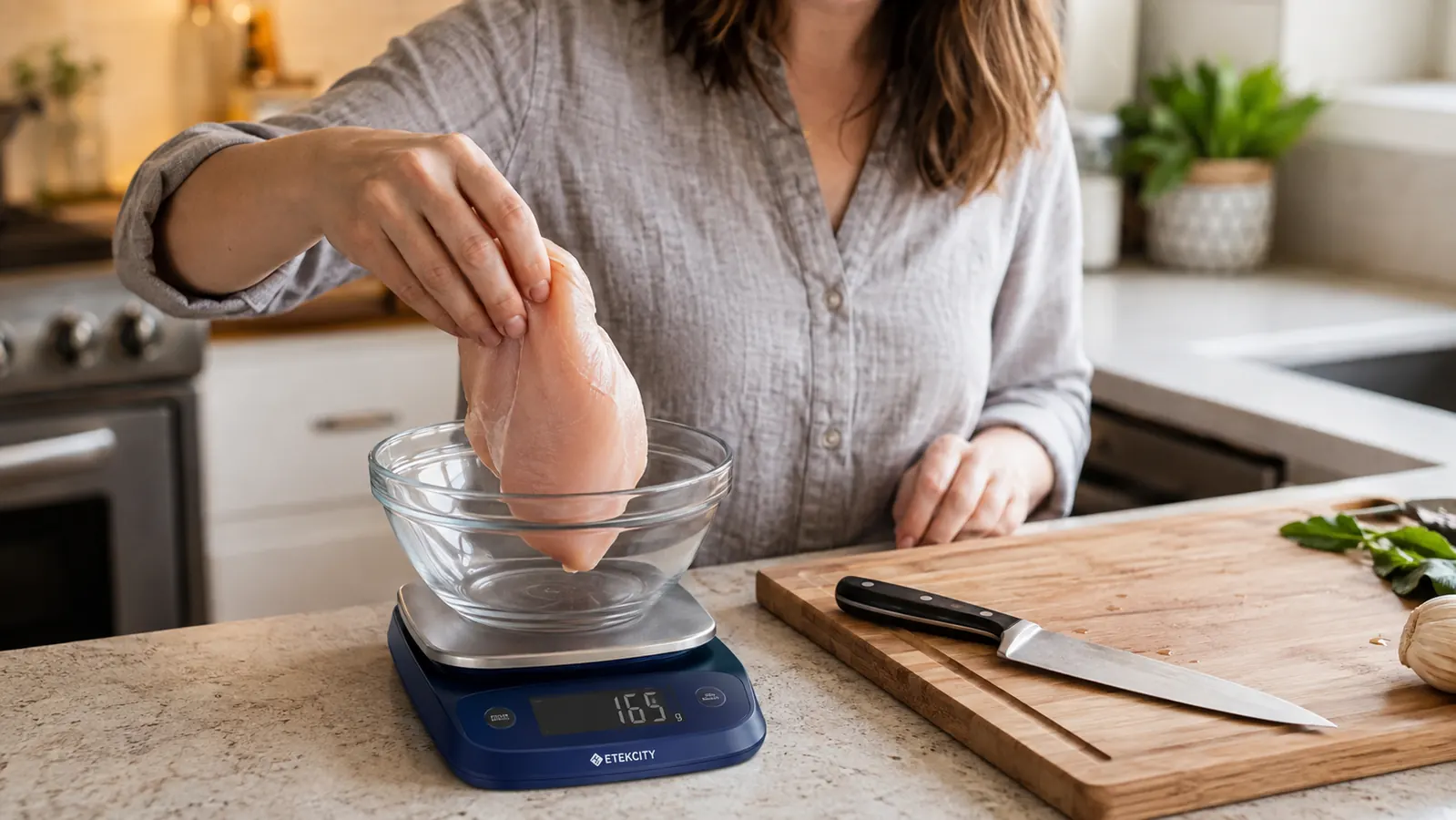
Raw protein is where portioning by weight pays off the most, because a package of chicken thighs or a pound of ground beef almost never splits into perfectly even pieces on its own. I set the scale to tare with an empty plate, then pull pieces off the package one at a time until I hit the target weight for that meal, trimming a little here or adding a sliver there rather than eyeballing the cut before I ever pick up a knife. For ground meat, I portion the whole pound into equal piles right after opening the package, before any of it goes into a pan, so every burger or meatball batch that week started from the same amount.
This matters most when a single package needs to stretch across more than one meal. A family pack of chicken breast that looks like "enough for a few dinners" is a lot more useful once you know it's actually enough for four dinners at a specific weight each, not three big ones and a skimpy fourth. Once I started doing this consistently, I stopped running out of protein mid-week and stopped overbuying at the store out of habit, since I actually knew how far what I already had would go.
Step 3: Portion grains and starches by weight after cooking, not before
Rice, pasta, and potatoes absorb water as they cook, which means the dry weight you started with and the finished weight in the pot are two completely different numbers. I weigh these after cooking, not before, straight out of the pot or pan once they've cooled enough to handle. Tare the empty container, scoop in cooked rice or pasta until the display hits the target, and move to the next container. It takes maybe thirty extra seconds per container over just eyeballing a scoopful, and it's the step that keeps five identical lunch containers from turning into one generous one and four thin ones.
Potatoes are the one place I still sometimes weigh raw, mostly when I'm roasting a tray of them and want even pieces that cook at the same rate, since uneven chunks mean some come out mushy while others are still firm in the middle. For anything going into a shared container with a protein and a vegetable, though, I weigh the starch last, after it's cooked and cooled slightly, so the number on the display reflects what's actually going to end up on the plate.
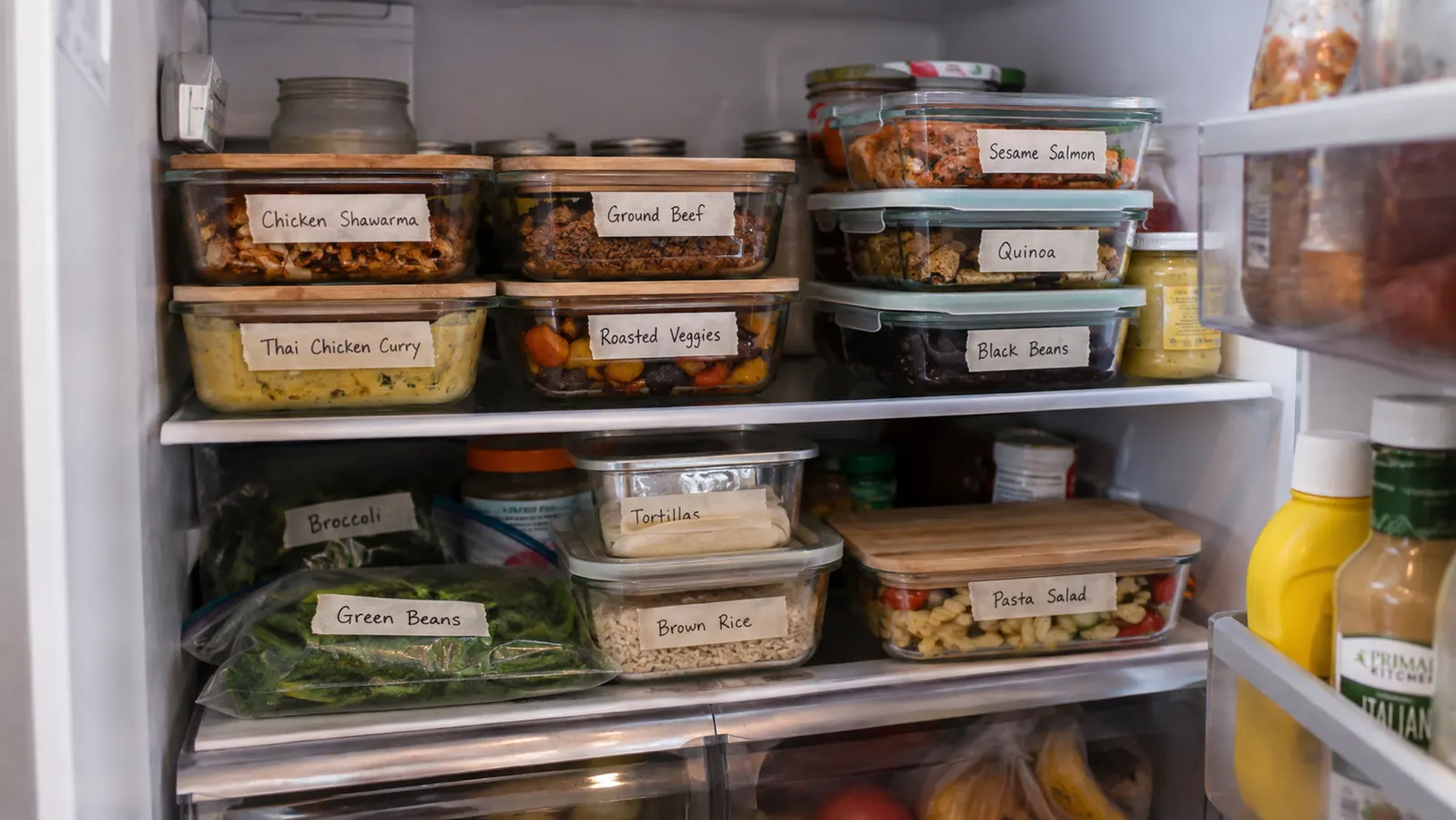
Step 4: Batch portion right after you cook, while everything's still on the counter
The window right after cooking, before anything gets put away, is the only time I actually portion a full batch out. If I wait until later, or try to do it cold out of the fridge the next day, it takes twice as long and the food doesn't come apart as cleanly. I line up every container I'll need on the counter first, tare the scale with one sitting on top, fill it to the target weight, then move the scale itself to the next container rather than moving food back and forth between dishes trying to get the number right.
This is also where a scale earns its keep on the budgeting side of things, not just the consistency side. A bulk pack of chicken thighs or a big bag of rice is cheaper per pound than buying smaller portions throughout the week, but only if you actually use what you buy instead of losing track of it in the back of the fridge. Portioning and labeling everything right after cooking is what turns a bulk buy into real savings instead of food that quietly goes bad because nobody remembers how much is left or what it was for.
I write the weight and the date on painter's tape stuck to the lid of each container. It's a small habit, but it means I can glance at the fridge shelf and know exactly what's in each one without opening a single lid, and I'm not stuck guessing whether a container has been in there three days or ten.
Step 5: Build a personal reference sheet so you stop reweighing the same things
After a few weeks of weighing the same handful of meals, patterns show up. I keep a running note on my phone with the weights that actually work for my household, one raw chicken breast portion for a stir-fry, one cooked rice portion for a bowl, one ground beef portion for tacos. It's not a formal recipe card, just numbers next to plain descriptions, but it means I'm not starting from scratch every single time I cook something I've made before. I dig into how this reference sheet came together, and how it changed over the first few months of actually using the scale daily, in my longer notes on living with this scale.
The reference sheet is also what makes portioning fast instead of tedious. Once you know your household's chicken breast portion is a specific weight, you're not thinking about it anymore, you're just watching the display climb to a number you already have memorized. That's the point where a scale stops feeling like an extra step in cooking and starts feeling like the fastest way to get dinner on the table without a pile of dishes that came out three different sizes.
Portioning Leftovers for the Freezer
Freezer portions are where a scale saves the most real waste. Without weighing, a freezer bag of soup or chili tends to be whatever fit in the container that was closest at hand, which means one bag feeds two people and the next feeds four, and neither is labeled clearly enough to tell which is which by the time you actually need it. I portion into freezer bags laid flat on the scale, tare with the empty bag in place, fill to the weight I want, then press it flat and label the weight and date on the bag itself with a marker before it goes in the freezer.
This matters more for freezer meals than fridge ones because you're often pulling a bag out weeks later with no memory of how it was portioned in the first place. A bag labeled with an actual weight tells you immediately whether it's enough for a weeknight dinner for the household or just a lunch for one person, without thawing it first to find out. I stopped ending up with a freezer full of unlabeled mystery bags once I started doing this, and I stopped throwing out freezer-burned portions that were clearly too small to bother using and too awkward to combine with anything else.
What Else Helps
A scale solves the weighing part, but a few other things make the whole system hold together. Uniform, stackable containers matter almost as much as the scale itself, since portioning perfectly and then jamming everything into mismatched tubs undoes half the benefit, you lose track of what's what and containers stop stacking flat in the fridge. I keep the scale somewhere it's actually reachable, on the counter or in the first cabinet I open, not buried behind the mixer, because a scale that takes effort to get to is a scale that gets skipped on a busy weeknight. A cheap set of tongs also earns its spot next to the scale, since moving hot, portioned food from pan to container without disturbing the weight you just measured is easier with tongs than with a spoon that squishes things around.
Shopping changes a little too once you're used to thinking in weights instead of guesses. Recipes that list ingredients in ounces or grams stop being a translation problem, and grocery trips get easier to plan because you know roughly how many portions a given package will actually yield instead of estimating on the fly in the store aisle. None of this requires giving up recipes that use cups and tablespoons for spices or liquids, a scale isn't meant to replace every measuring tool in the kitchen, just the ones that were never good at measuring solid food to begin with.
The scale didn't make me a better cook. It made every serving I already knew how to make come out the same size twice in a row.
Same size portion, every single time you cook it
That's the actual trade a kitchen scale makes. It's not about eating less or eating a certain way, it's about not running out mid-week and not wasting the extras nobody planned for.
Amazon Check Today's Price on Amazon →